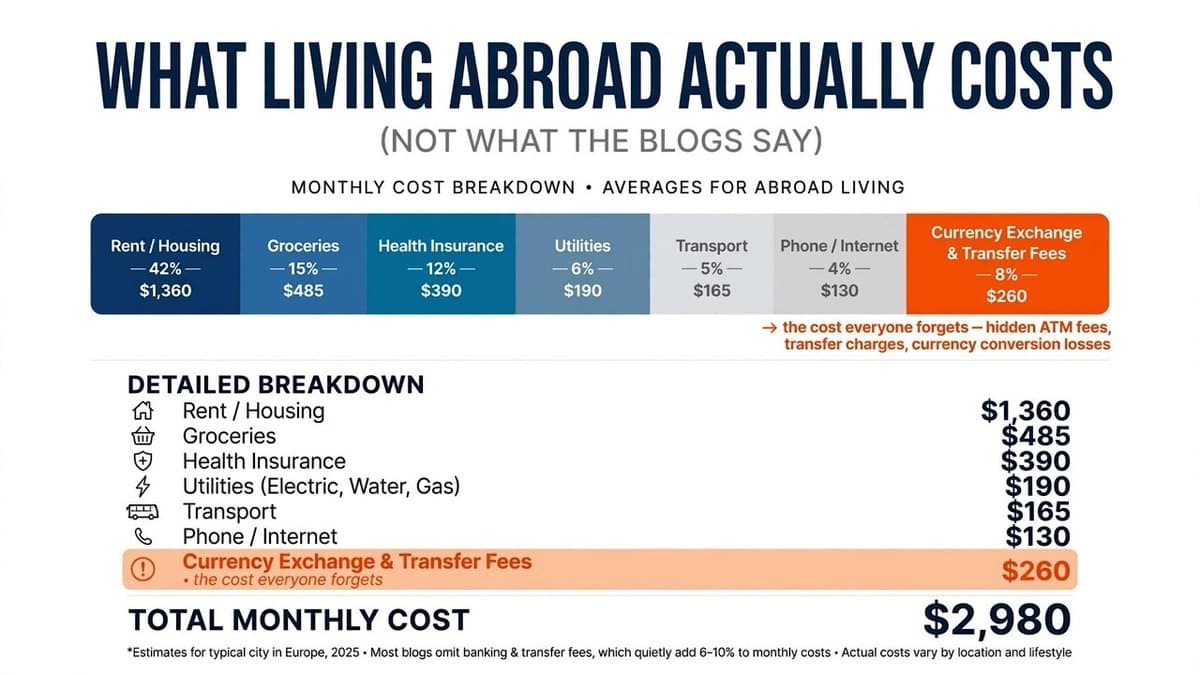
What Living Abroad Actually Costs: A Realistic Budget Guide for Digital Nomads
The Instagram Fantasy vs. Financial Reality
Written by Ron Kloth, Founder of NomadJobPass.
This is educational information, not financial, legal, or tax advice. Costs, exchange rates, and visa fees vary significantly by location and change over time. Verify current costs directly and consult qualified professionals before making financial decisions. Nothing in this guide creates a client-advisor relationship.
You've seen the posts: "I live in Bali for $800 a month!" What those posts rarely mention is what they're leaving out.
Realistic nomad budgets vary enormously by destination tier. Commonly cited market research puts the average around $1,200–$2,500/month for a typical mid-range lifestyle, climbing well past $4,500 in higher-cost Western destinations. The "$800 paradise" claims usually describe one specific low-cost city, one specific frugal lifestyle, and quietly leave out several categories of cost most first-time nomads don't think to budget for at all.
Having lived in multiple countries in Europe I have personally seen the wide discrepancy you can pay. In Germany and Portugal just my rent alone averaged between $1000 to $1300 USD while in Albania I pay about $450 USD a month.
This guide isn't about selling the nomad dream. It's a framework for budgeting accurately, so the costs below don't derail your first few months the way they derail so many others.
The Obvious Costs Everyone Budgets For
Rent: typically 30-40% of the budget. Food: groceries and eating out. Transport: local transit, ride-sharing, or a scooter rental. These are the headline numbers everyone starts with. They're also incomplete.
The Costs People Consistently Miss
Short-term housing premiums. The cheap rent figures you see online are usually long-term-lease prices available to locals, not the furnished short-term rentals nomads actually book. Short-term furnished rentals commonly run noticeably higher than local long-term leases for the same unit. When estimating housing costs from an "average rent" figure you found online, padding it upward is more realistic than taking that number at face value.
International health insurance. Many visas require proof of it. Traveling without it anywhere is a real financial risk regardless. Basic travel insurance starts in the range of $45+/month for emergency-only coverage. Comprehensive plans with routine and mental health care run considerably more. Getting sick abroad without coverage is one of the more financially devastating things that can happen to a nomad. Local "free" healthcare for citizens generally doesn't extend to visitors.
Visa and immigration costs. Application fees, document translations and notarizations, background checks with apostilles, and sometimes legal or consultant fees, before counting "visa runs" (flights to a neighboring country to extend a stay), which add up over a year. Research the full cost of a specific visa process before committing to a destination, and verify current fees on the official government site rather than a blog (see How to Evaluate a Digital Nomad Visa).
Currency conversion and banking friction. ATM withdrawal fees, foreign transaction fees (commonly a couple percent per purchase), poor bank exchange rates, and international wire fees add up over a year in ways that are easy to underestimate. A no-foreign-transaction-fee travel card and an ATM-fee-reimbursing debit card meaningfully reduce this. When a foreign merchant offers to charge you in your home currency instead of local currency, decline. That conversion is almost always worse than what your own bank would give you.
Flights between destinations and trips home. Moving countries every couple of months means recurring flight costs beyond the initial one-way ticket, plus the cost of getting home for holidays, weddings, or emergencies, plus the occasional unexpected rebooking fee. This is one of the biggest reasons "cheap living" claims fall apart under a full accounting.
Coworking space and internet backup. A café works for a day or two. A dropped connection during an important call is when most nomads realize they need a real backup. Coworking memberships, a local SIM with data, or a backup hotspot device are all worth budgeting for as ongoing costs, not one-time purchases.
Tax prep and accounting help. US citizens owe US taxes regardless of location (see Digital Nomad Taxes 101), and navigating foreign tax obligations on top of that often genuinely requires professional help. "I'll figure it out later" is a recurring, expensive mistake.
The "bureaucracy tax." Mail forwarding, a storage unit for belongings left behind, maintaining a home-country address for banking and taxes, renewing a license or certification, responding to a jury duty summons from thousands of miles away, the costs of maintaining a life back home don't disappear just because you're not physically there.
Why Cost-of-Living Indices Mislead Nomads
Cost-of-living calculators report steady-state local expenses, not nomad realities. They assume long-term leases (not short-term furnished rentals at 2–3x the price), grocery shopping (not eating out in tourist areas), and local commuting (not flights, visa runs, coworking). They completely miss setup costs, visa fees, international insurance, currency conversion friction, and the "pace tax" of moving frequently. Use them as a rough guide only, paired with real-time city research and a 30% budget buffer.
Online calculators are popular and frequently misleading for this specific use case, for a simple reason: they're built for locals, not nomads. Rent figures assume long-term local leases, not short-term furnished rentals. Food figures assume grocery shopping, not eating out or sourcing specialty ingredients. Transport figures assume local commuting, not intercity travel or visa runs.
Two things they miss entirely:
The pace tax. Moving frequently (every week or two) costs meaningfully more per month than staying put for 30+ days in the same place, thanks to higher nightly rates, more transport, and the occasional costly mistake that comes with less familiarity.
Setup costs. Indices report steady-state monthly numbers, not the disproportionately expensive first few months, accommodation deposits, gear purchases, and simply not yet knowing where the cheap grocery store is. Padding the first month's budget well above a normal month's is more realistic than assuming month one looks like month four.
Building a Realistic First-Three-Months Budget
Step 1, pick a destination tier. Low-cost (much of Southeast Asia, Eastern Europe, parts of Latin America), mid-cost (Southern Europe, Mexico, Costa Rica), or high-cost (Western Europe, US, Japan). Each tier implies a meaningfully different monthly baseline, and city matters as much as country (a capital city routinely costs more than a secondary city in the same country).
Step 2, estimate setup costs separately from monthly costs. Gear, the first flight, an accommodation deposit, visa fees, and the first insurance payment are all one-time or front-loaded costs that a steady-state monthly budget doesn't capture.
Step 3, build the monthly number category by category, not as a single guess: accommodation, food, coworking, phone/internet, insurance, local transport, amortized flights, entertainment, and software/subscriptions each deserve their own line.
Step 4, add a real safety buffer. A commonly cited rule of thumb is 3-6 months of baseline expenses saved before leaving, with freelancers and variable-income earners leaning toward the higher end of that range given less income predictability.
A Worked Example: Illustrative, Not a Quote for Any Specific Place
For a mid-cost destination, a full accounting (not just the "headline" rent+food+transport number) commonly lands well above what the headline number alone would suggest, often by 30% or more once coworking, insurance, amortized flights, and entertainment are added in, and Month 1 specifically runs higher still once setup costs are included on top of the steady-state monthly figure. The gap between the number people quote casually and the number that actually clears their bank account is almost always these categories, not the ones everyone already budgets for.
Frequently Asked Questions
How much money do I need to become a digital nomad? Commonly cited guidance is $5,000-$10,000 saved before starting, covering several months of expenses plus setup costs and a buffer for income variability.
What's the average monthly cost for a digital nomad? It varies enormously by destination tier, roughly $1,200-$2,500/month is a commonly cited average for a mid-range lifestyle, climbing well past $4,500 in higher-cost Western destinations. Your actual number depends heavily on destination, move frequency, and lifestyle choices.
What hidden costs do most nomads forget? International health insurance, visa fees, currency conversion friction, coworking memberships, flights between destinations, and tax prep help, none of them huge individually, but they add up to a meaningful share of a real budget.
Are cost-of-living indices accurate for nomads? Generally not. They're built for local salaries and family households, missing short-term housing premiums, the pace tax of frequent moves, and nomad-specific costs entirely. Use them as a rough starting point, not a final number.
Why is the first month more expensive than later ones? Setup costs, deposits, gear, visa fees, and the "not knowing where to shop yet" premium, front-load real expense into month one that a steady-state monthly budget doesn't capture.
Do I need to pay taxes as a digital nomad? US citizens owe US taxes regardless of location. Other nationalities may still have filing obligations depending on tax residency and treaties (see Digital Nomad Taxes 101). This is exactly the kind of thing "I'll figure it out later" gets expensive on.
What's the "pace tax"? The extra cost of moving frequently, more nightly-rate housing, more transport, more re-buying essentials in each new place, versus staying somewhere long enough to access local rates and routines.
Is coliving cheaper than renting solo? Often, since it typically bundles accommodation, workspace, and utilities into one price, with better rates for longer stays.
How NomadJobPass Helps
Once the budget and destination are sorted, the missing piece is the income to fund it. NomadJobPass helps with the job-search side specifically, tailored applications for remote roles, resume optimization for international markets, and interview preparation for location-independent positions. Good Luck
Related reading: Digital Nomad Taxes 101 · How to Evaluate a Digital Nomad Visa
Sources
- Ohayu. "Digital Nomad Budget, 2026 Spending and Saving Guide." Verified directly during review. Their stated 2026 average is $1,200–$2,500/month for a mid-range lifestyle, the wider $1,500–$4,500 range used in this guide's opening reflects the full spread across cost tiers (their figure centers on budget/mid-tier destinations, not high-cost Western ones), not a conflicting number.
- Digital Nomad Lifestyle. "Cost of Living in Europe for Digital Nomads."