Writing the Perfect Thank You Note After Your Remote Job Interview
A Complete Guide to Following Up in the Virtual Hiring Era
Written by Ron Kloth, Founder of NomadJobPass.
Quick answer: Send it within 24 hours, to each interviewer separately if there was more than one. Reference something specific from the actual conversation, not "thank you for your time." Structure it in three parts: gratitude with a specific callback, brief enthusiasm, a clean close. Keep it to 3–5 sentences.
You just finished your remote job interview. You closed your laptop, let out a breath, and felt a wave of relief. The conversation flowed well. Now what?
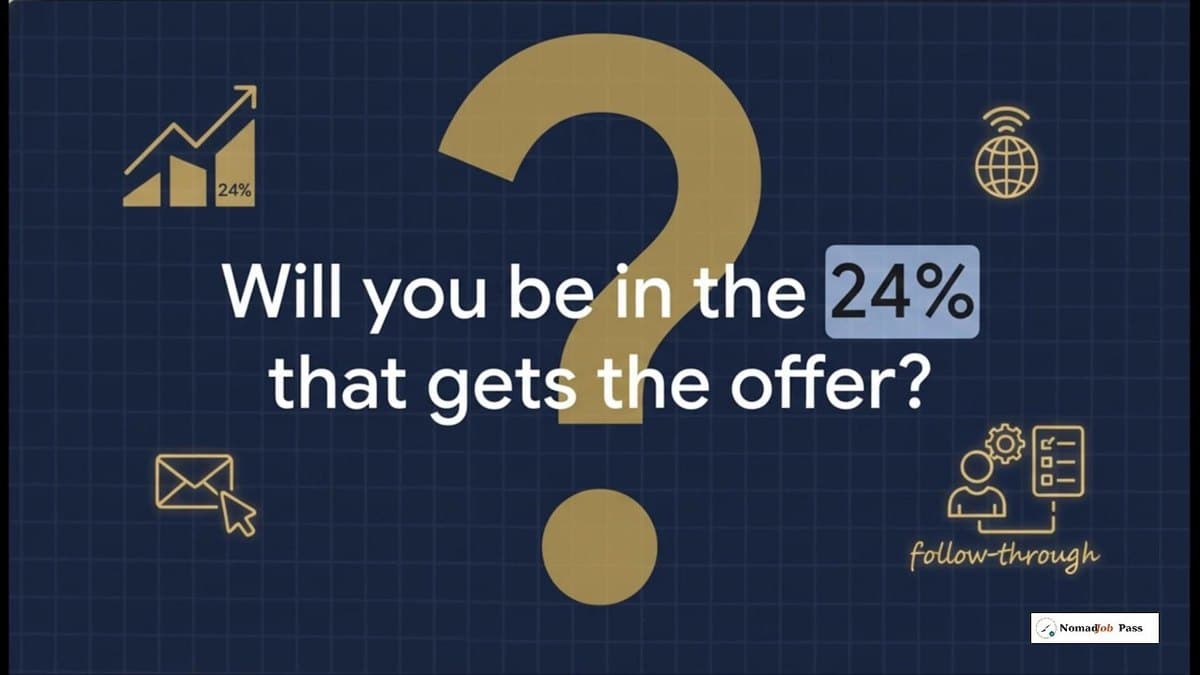
Here's the uncomfortable part: 68% of hiring managers say a thank-you note impacts their decision-making, and roughly one in five have dismissed a candidate outright for not sending one. Yet only about 24% of candidates actually send one. Most job seekers who perform well in the interview are quietly skipping a step that a majority of the people deciding their fate say actually matters.
In a remote interview, this gap matters more, not less. There's no handshake, no walk to the elevator together, no small moment of in-person warmth to leave on. Your follow-up email is the entire remaining impression you get to make.
Why It Matters More in Remote Hiring
A thank-you note does a few concrete things: it demonstrates genuine interest in a way a resume can't, it reinforces fit by referencing specifics from the real conversation, and it compensates for the lack of physical presence that in-person interviews get for free.
It's worth being precise about what it actually is, though: a tiebreaker, not a qualifier. It won't make an underqualified candidate look qualified. But in the "muddy middle", where two candidates are genuinely close on skills and experience, a specific, well-timed note is exactly the kind of small signal that tips a close call. That's a real, bounded claim, not hype.
When to Send It
Within 24 hours. The conversation is still fresh for both of you, you stay top of mind while the interviewer is still evaluating other candidates, and prompt follow-through is itself a signal remote employers are specifically looking for.
If you interviewed on a Friday, send it Sunday afternoon or first thing Monday. The 24-hour window is about business responsiveness, not literally counting weekend hours.
If you spoke with more than one person, send a separate, personalized note to each. A group email or a copy-pasted note to multiple interviewers reads as exactly what it is. Companies sometimes forward these notes into a shared file, and generic ones are easy to spot next to specific ones.
The Three Parts That Actually Matter
1. Gratitude. Thank them for their time, specifically, not generically. "Thank you for walking me through how the team handles X" beats "thank you for your time" every time.
2. A specific callback. This is where most notes fail. Reference something real from the conversation, a challenge they mentioned, a project they're excited about, a detail about the team. It's the difference between a note that proves you were listening and one that could have been sent to any company for any role.
3. A clean, forward-looking close. State your continued interest plainly. Skip the filler ("please don't hesitate to reach out if you need anything"). It doesn't add anything and it's in every template ever written.
A Real Example
Subject: Great meeting you, [Name]
Hi [Name],
Thank you for walking me through how the team's been handling campaign timing across regions this morning. That time-zone coordination challenge is exactly what I spent the last two years solving at [Company], and I'd genuinely enjoy digging into it further with your team.
I'm very excited about this opportunity, and I look forward to hearing about next steps.
Best, [Your Name]
Short, specific, and closes without over-asking.
What If You Don't Hear Back?
Silence for a few days doesn't mean bad news. Hiring managers are juggling multiple candidates and their regular workload. If a full week passes with nothing, one brief, polite follow-up is appropriate:
Subject: Following up on my interview
Hi [Name],
I wanted to follow up on my interview from last week. I remain very interested in the role and would love to know if there's any update on timing.
Thanks again for your time.
Best, [Your Name]
One follow-up after a week is normal. A second one in quick succession starts to read as pressure, not interest.
Why Generic Notes (AI-Written or Otherwise) Fall Flat
Plenty of candidates skip the note entirely. Plenty more send something so generic it might as well be blank, and increasingly, that includes notes generated by pasting a job title into an AI tool and hitting send without adding anything real. The problem isn't that AI wrote a draft. It's that nothing specific to the actual conversation ever got added to it. A hiring manager can tell the difference between a note that references something only that conversation would contain, and one that's technically correct but could have gone to anyone.
That's the whole design behind NomadJobPass's own follow-up email feature, and it's worth being direct about how it actually works, tier by tier: every prep, free or paid, includes a basic follow-up email draft the moment you generate your documents, built from the job posting itself. It's a real starting point, not nothing, but it's written before your interview happens, so it can't reference a conversation that hasn't occurred yet. Use it as a draft, not a final answer: add one real detail from your actual conversation before sending it.
Premier users get a second option once they've actually interviewed: mark the application "Interviewing" in your Job Tracker, answer two or three quick questions about what was actually discussed, and NomadJobPass generates a tailored follow-up email built around those specifics, the same three-part structure from this guide, done automatically from your real conversation instead of a template you fill in by hand.
Practice Before You Need It
Keep your note to five sentences or fewer. Read it out loud once before sending. It should sound like you, not like a template. And don't let "getting it perfect" become the reason it never gets sent within the 24-hour window that actually matters. I think this is one of the most important things to remember.
The gap between the 68% of hiring managers who say this matters and the 24% of candidates who act on it is the whole opportunity here. It costs five minutes and changes nothing at the extremes, but in a close call, it's exactly the kind of small, specific thing that tips it.
Frequently Asked Questions
Nine practical questions cover the mechanics hiring managers actually care about: timing (24 hours), contact info sourcing, length (3–5 sentences), personalization per interviewer, template risks, non-response follow-up, salary mentions, tone pitfalls, and medium choice. Core rule: specific + grateful + brief.
When should I send a thank you email after a remote interview? Within 24 hours. If you interviewed on a Friday, send it Sunday afternoon or first thing Monday.
What if I don't have the interviewer's email address? Ask your recruiter or HR contact before the interview ends, or ask the interviewer directly. It's a completely normal request. If all else fails, send it to the recruiter and ask them to forward it.
How long should the note be? 3 to 5 sentences. Hiring managers are busy. A concise, specific note outperforms a long one.
Should I send a separate note to each interviewer? Yes, always, reference something specific from your conversation with each person individually. Group or copy-pasted notes read as exactly that.
Is it okay to use a template? For structure, yes. Never send one verbatim, always add a specific, real detail from your actual conversation. A generic template is only marginally better than sending nothing.
What if I don't hear back after sending my note? Don't read it as a bad sign. Wait a full week, then send one brief, polite follow-up. A second follow-up in quick succession starts to feel like pressure rather than interest.
Should I mention salary or benefits in the thank-you note? No, save that for later stages. The note is for gratitude and specific interest, not negotiation.
What's the one thing to avoid? Sounding entitled or presumptuous, phrases like "I expect to hear back by Tuesday." Stay grateful, specific, and brief.
Is a handwritten note better than email for a remote interview? Email is faster and more reliable within the 24-hour window that actually matters for remote hiring. A handwritten note afterward can be a nice extra touch, but it shouldn't be your primary or only follow-up.
Sources
A thank-you note works when it is specific, short, and sent within a day. The rules below cover timing, length, personalization, and what to leave out, with a template you can rewrite in your own words.
- Harvard Law School: Interview Follow-Up: Thank-You Notes. Official guidance on timing, format, and best practices for post-interview follow-up communications.
- Emory University Career & Professional Development: Writing Thank-You Letters. Best practices for tone, structure, and impact in post-interview correspondence.
- Boston University Career Services: After Interview Resources. Comprehensive guidance on follow-up strategies and what hiring managers expect after interviews.
Related reading: The Interview Answer That Actually Works