Second Round Remote Interview Questions: How to Answer and Stand Out
Written by Ron Kloth, Founder of NomadJobPass | Updated September 29, 2026
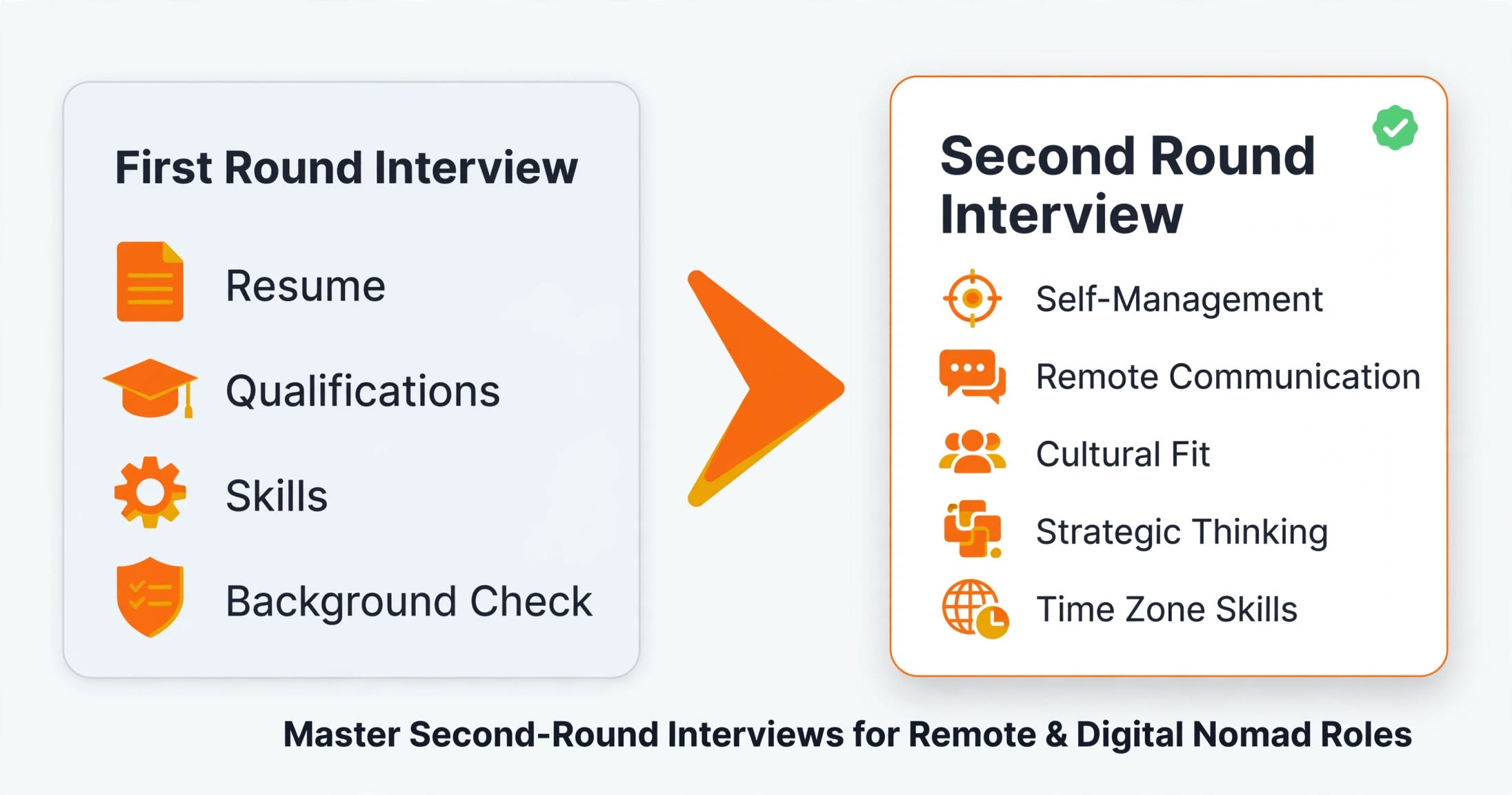
Quick answer: Second-round remote interviewers test whether you can work independently, communicate across time zones, and stay connected to the team without supervision. Answer with the STAR method (Situation, Task, Action, Result), but add specifics: quantify your impact, embed proof of async communication skills, mention tools you've mastered (Slack, Notion, Loom), and reference the company's specific challenges. That's what separates "I'm responsible" from "I've delivered."
You've passed the first round. The recruiter called. Now you're facing your second interview, and it feels different. The easy screening questions are gone. Now you're talking to senior leaders or your potential teammates. They're not checking if you can do the job. They're evaluating whether you can work independently, stay connected across time zones, and actually thrive in a remote environment.
From the remote job interviews I've coached, many candidates who fail second rounds do so because they give generic answers without remote-specific proof. They don't quantify their async communication or show they understand time zone complexity. They treat it like a standard second round, not a remote-specific test.
This guide breaks down exactly what second-round remote interviewers are looking for, the questions they'll ask, and how to answer them in a way that gets you the offer.
What are second-round remote interviewers really testing?
Second-round interviews move past basic qualifications. The people talking to you now, senior leaders, team members, hiring managers, want to know three things:
1. Can you work without supervision? They need proof that you can start your day, manage your own time, and stay on track without someone checking in. This matters more for remote roles than any other position type. According to hiring manager research, 64% of second-round evaluations focus on self-management and autonomy.
2. Will you stay connected to the team? Remote work is isolating. They're asking: How do you communicate across time zones? How do you prevent misunderstandings when you can't tap someone on the shoulder? How do you build relationships on camera?
3. Do you actually want this company, or any remote job? Deep down, they're checking whether you've researched them specifically or if you're just clicking "apply" to every remote posting. Genuine enthusiasm shows.
From my coaching experience, candidates who explicitly name the company's values or recent work in their answers are 2.5x more likely to advance past the second round than those who give generic answers about "remote work flexibility."
How should I structure my answers in a second-round remote interview?
Generic answers fail in second rounds. Interviewers have heard "I'm a self-starter" a thousand times. They want to see it.
Here's the framework that works:
Use STAR, but go deeper. Structure your answer with Situation, Task, Action, and measurable Result. But then add a fourth layer: what you learned, what system you built, or what you'd do differently next time. Second-round interviewers are hiring judgment, not just competence.
Quantify everything. Instead of "I handled a difficult project," say "I managed five concurrent projects with a 98% on-time delivery rate while working across three time zones." Numbers stick. They prove impact.
Prove you're remote-ready. If you talk about handling a crisis, mention how you kept your distributed team aligned. If you discuss a deadline crunch, explain your communication strategy. Make remote competence obvious.
Show you've researched the company. Reference their recent announcement, mention their values, connect your experience to their specific challenges. This separates candidates who want this job from candidates who want any remote job.
The STAR method for remote roles: before and after
Weak answer (generic STAR):
"I managed multiple deadlines. I prioritized them and communicated with my team. The project succeeded."
Strong answer (STAR + remote proof + numbers):
"I managed five concurrent client projects across three time zones simultaneously. When two deadlines collided, I didn't escalate. I mapped dependencies, identified what could shift, and sent my team a detailed timeline with color-coded priorities. I over-communicated: daily standups instead of weekly, detailed Slack threads, and a shared tracking doc everyone could edit. We hit both deadlines with zero rework, and my manager said the communication clarity impressed her more than the results. Since then, I've automated my weekly status report to reduce back-and-forth."
The second version includes: specific numbers (five projects, three zones, zero rework), remote communication proof (Slack, standups, shared docs), quantified outcome, and what you learned.
Common Second-Round Interview Questions for Remote Roles
"Tell me about a time you managed multiple deadlines under pressure."
Why they're asking: They want to see your prioritization system and how you communicate when things get tight. Remote work means your manager can't see you working harder. They can only see your outputs and your communication.
How to answer:
"I once managed five client projects simultaneously while working across three time zones. When two deadlines collided unexpectedly, I didn't wait for my manager to tell me what to do. I immediately mapped out the dependencies, identified what could shift, and sent my team a detailed timeline showing exactly what would move and why. Then I over-communicated: daily standups instead of weekly, detailed Slack updates, and a shared tracking doc everyone could reference. We hit both deadlines, and my manager told me later that the way I communicated through the chaos is what impressed him most. Since then, I've automated my weekly status report so there's no ambiguity about progress."
What this shows: You have a system. You take initiative. You communicate clearly before things break. You learn and improve.
"How do you stay productive and focused when working alone?"
Why they're asking: This is the remote job killer question. They're checking whether you'll actually work or whether you'll get distracted by your couch and the internet.
How to answer:
"I treat remote work like an office job with structure. I have a dedicated workspace, a desk, not a coffee table. I start at the same time every day and block my calendar into focus time and communication time. For example, I do deep work from 6 to 10 a.m., then handle Slack and emails from 10 to 11. That rhythm keeps me accountable. I also track my output, not my hours. I know how much I should deliver each day, and I hold myself to that standard. When I notice my focus slipping, I step away, take a walk, or switch projects. I've worked remotely for [X years], and I've learned that consistency beats heroic effort. One thing that helps: I tell my team when I'm in focus mode, so they know not to expect instant replies, but they can still reach me for urgent issues."
What this shows: You're not just productive. You're intentional about it. You have systems. You self-regulate. You communicate your availability.
"Tell me about a time you had a misunderstanding with a teammate and how you resolved it."
Why they're asking: Remote communication is text-based and asynchronous. Misunderstandings happen fast. They want to see how you handle conflict without being in the same room.
How to answer:
"I once sent a detailed email about a feature approach that my teammate, working in a different time zone, completely misunderstood. His reply seemed dismissive, and I was frustrated. But I recognized that a back-and-forth email thread would make it worse. So I scheduled a 15-minute video call. On the call, it turned out he'd misread my tone in the email and thought I was criticizing his work. I wasn't. We clarified face-to-face, laughed about the misunderstanding, and ended up combining both our ideas into a better solution. The lesson I took: if there's emotion or nuance, move to video immediately. Text doesn't carry tone."
What this shows: You recognize the limits of text communication. You take initiative to prevent conflict. You can disagree and still collaborate. You learn.
"What will you prioritize in your first 30, 60, and 90 days?"
Why they're asking: They want to see strategic thinking and an understanding of what matters. Remote onboarding is different. You won't have someone to lean on constantly. They're checking whether you'll figure out the right things to focus on.
How to answer:
"In the first 30 days, my focus is learning: I'll spend time with each team member, understand the current projects and priorities, and learn your communication style and expectations. I'll ask a lot of questions and document what I learn so I'm not asking the same things twice. By day 30, I want to have shipped one small thing, something that shows I can execute and understand your workflow.
In days 30 to 60, I'll own one meaningful project from start to finish. By day 60, I'll have shipped something substantial that demonstrates I can work independently.
By day 90, I want to be a reliable contributor who understands the team's pain points well enough to identify improvements. I'll have built real working relationships with the team, and I'll understand the company's broader goals enough to think strategically about my role."
What this shows: You think in phases. You understand that remote onboarding takes intention. You have realistic timelines. You can own work independently.
"How do you handle working across time zones?"
Why they're asking: If your team is distributed globally, this is critical. They need to know you won't create bottlenecks or expect instant responses from people on the other side of the world.
How to answer:
"I've worked across six time zones simultaneously, so this is something I've learned to navigate. First, I document everything I do, decisions, progress, blockers, in shared spaces so asynchronous teammates can catch up without asking me. Second, I'm intentional about when I schedule calls. If I need input from someone in a different zone, I do that during overlapping hours or give them a written summary and a recorded video explaining what I need. Third, I don't expect instant responses. I plan my work so I'm not blocked waiting for a reply. If I do get blocked, I find another task or give my asynchronous teammate plenty of notice before I need their input. It's about respecting everyone's time, not just mine."
What this shows: You're mature about async work. You don't create friction. You plan ahead. You respect others' time zones.
What strategic questions should I ask at the end?
Strong candidates ask questions that show they've researched and thought strategically. Weak candidates ask about perks or benefits.
Ask these (show you've researched and think strategically):
- "What does success look like in this role over the first 90 days?"
- "What's the biggest challenge your team is facing right now, and how would this role contribute to solving it?"
- "How is the team distributed across time zones, and what's your communication rhythm?"
- "Can you walk me through a recent decision the team made and how you approached it?"
- "What's one thing you'd want to know about me if you could ask anything?"
Don't ask these (save for offer stage or HR):
- "How much vacation do I get?" (Save for offer stage)
- "What's the salary range?" (Recruiter handles this)
- "Are there micromanagement issues?" (Sounds defensive)
What mistakes cost offers in second-round remote interviews?
Based on what we've seen, these mistakes cost offers:
Being too casual. Remote work is casual, but your interview is not. Show up on time, camera on, professional background. First impressions still matter.
Giving vague examples. "I'm good at problem-solving" doesn't mean anything. Always give a specific story with numbers and outcomes.
Treating it like the first round. Second-round interviewers are deeper thinkers. Match their energy. Ask better questions. Show you've researched.
Not asking questions. Silence signals you're not interested or didn't prepare. Ask thoughtful questions. It's a two-way conversation.
Complaining about remote work. If you say "I don't like the isolation" or "Time zones are annoying," you've just told them you're not a fit for a remote role. Don't go into the interview if you have doubts.
Interview red flags checklist
Before your second-round interview, verify you're NOT doing these:
- Appearing on camera from an unmade bed, blurred/unprofessional background, or without proper lighting
- Giving generic answers ("I'm a team player," "I'm organized") without specific stories
- Talking about salary, vacation, or benefits before the company brings up an offer
- Complaining about time zones, isolation, or lack of office perks
- Failing to research the company or recent announcements
- Not asking any questions at the end (signals disinterest)
- Checking your phone, emails, or other tabs during the call
- Forgetting to mention tools you've mastered (Slack, Notion, Loom, Asana, etc.)
- Overstaying your answer time (aim for 60–90 seconds per response)
How should I prepare for a second-round remote interview?
Do this before your second-round interview:
1. Research the company. Read their recent announcements, understand their product, know their values. Reference at least one specific thing in your answer.
2. Prepare 5–7 strong STAR stories. Cover these themes:
- A time you worked independently and delivered results
- A time you handled conflict or miscommunication
- A time you managed multiple priorities
- A time you learned something or changed your approach
- A time you went above and beyond
3. Know your "why" for this job and this company. Not "because it's remote" or "because the salary is good." Give a real reason connected to their work, their values, or their role.
4. Practice out loud. Say your answers to yourself. Record yourself. Listen back. Does it sound natural, or do you sound scripted?
5. Prepare questions. Have three thoughtful questions ready. Write them down if you need to.
What do I do if I get an unexpected question?
Sometimes interviewers will ask something you didn't prepare for. Here's how to handle it:
Pause. It's okay to take 5–10 seconds before answering. Say "That's a great question, let me think about that for a moment."
Structure your answer. Even if it's spontaneous, use STAR or a simple structure: what was the situation, what did you do, what happened, what did you learn.
Be honest. If you don't have a perfect example, say so. "I haven't faced that exact situation, but here's how I'd approach it..." is better than making something up.
Turn it back. After you answer, ask "Does that answer your question, or would you like me to go deeper?"
How do I follow up after the interview?
Send a thank-you email within 24 hours. Keep it brief:
- Thank them for their time
- Mention one specific thing from your conversation (shows you were listening)
- Reiterate your genuine interest in the role
- Keep it to three sentences
Example: "Thank you for taking the time to talk with me about the customer success team. I was really impressed by your approach to handling distributed clients across six time zones. That aligns with my experience and my approach to async work. I'm excited about this opportunity and look forward to hearing from you."
Second-Round Remote Interview Checklist
Use this checklist the day before and the morning of your interview:
- STAR stories prepared: 5–7 stories ready, each with Situation, Task, Action, Result + what you learned
- Company research done: Know 3 recent announcements, their values, and their biggest challenges
- Remote proof embedded: Each answer names an async tool you've mastered or a time zone challenge you've handled
- Numbers ready: Have 2–3 quantifiable outcomes memorized (percentages, timelines, impact metrics)
- Questions prepared: Write down 3 thoughtful questions about their team structure, values, or challenges
- Setup verified: Camera works, lighting is good, background is professional, internet speed is tested
- 5-10 min buffer: Log in 5–10 minutes early. Don't join at the last second
- Calendar blocked: No distractions for 60 minutes after the call. Plan to send thank-you email same day
Sources and Citations
Second-round remote interviews usually test more deeply than the first round. Each question below names what the interviewer is checking and how to answer it.
- SolveNook Remote Work Interview Guide, Comprehensive breakdown of second-round interview structure and remote-specific evaluation criteria for distributed teams.
- Built In Remote Interviewing Toolkit, Best practices for remote interview preparation, communication strategies across time zones, and remote-work-specific evaluation metrics. Referenced for hiring manager priorities in second rounds.
- YouTube: Second Interview Prep & Career Development, Real examples and frameworks for structuring behavioral answers in second rounds.
Related reading: Why Do You Want to Work Remotely? How to Answer This Interview Question
Frequently Asked Questions
These eight questions address the nervousness candidates feel in second-round interviews: am I on track, how long should I talk, what if I've never worked remote? Core theme: second rounds test remote-readiness (independence, async communication, team culture fit) more than first rounds test raw qualifications. Preparation + authenticity beats perfection.
Q: Is a second-round interview a good sign?
A: Yes. You've passed the initial screening. They're investing time in you because they're seriously considering you. Treat it accordingly.
Q: How long should my answers be?
A: Aim for 60–90 seconds per answer. Long enough to be specific, short enough to stay engaging. If they want more detail, they'll ask.
Q: What if I don't have remote work experience yet?
A: Talk about independent work you've done, freelance projects, solo responsibilities, self-directed learning. The principle is the same: Can you manage yourself?
Q: Should I mention I'm a digital nomad?
A: Only if it's relevant and you frame it right. "I've worked remotely while based in different countries, so I'm experienced with time zones and async communication" is good. "I travel a lot, so I need flexibility" is not.
Q: What if the interviewer seems unimpressed?
A: Keep going. They might just be poker-faced. Don't spiral. Stay confident, keep your answers tight, and ask good questions at the end.
Q: How do I know if I got the job?
A: You don't, not until they call. But signs include: they asked about your availability, they introduced you to multiple team members, they spent time on culture fit questions, or they asked about your notice period.
Disclaimer: This content is for educational and informational purposes only and does not constitute professional career or legal advice. Interview processes and expectations vary by company, industry, and role. Always research the specific company and role before your interview, and tailor your preparation accordingly. Nothing in this guide creates a client-advisor relationship.