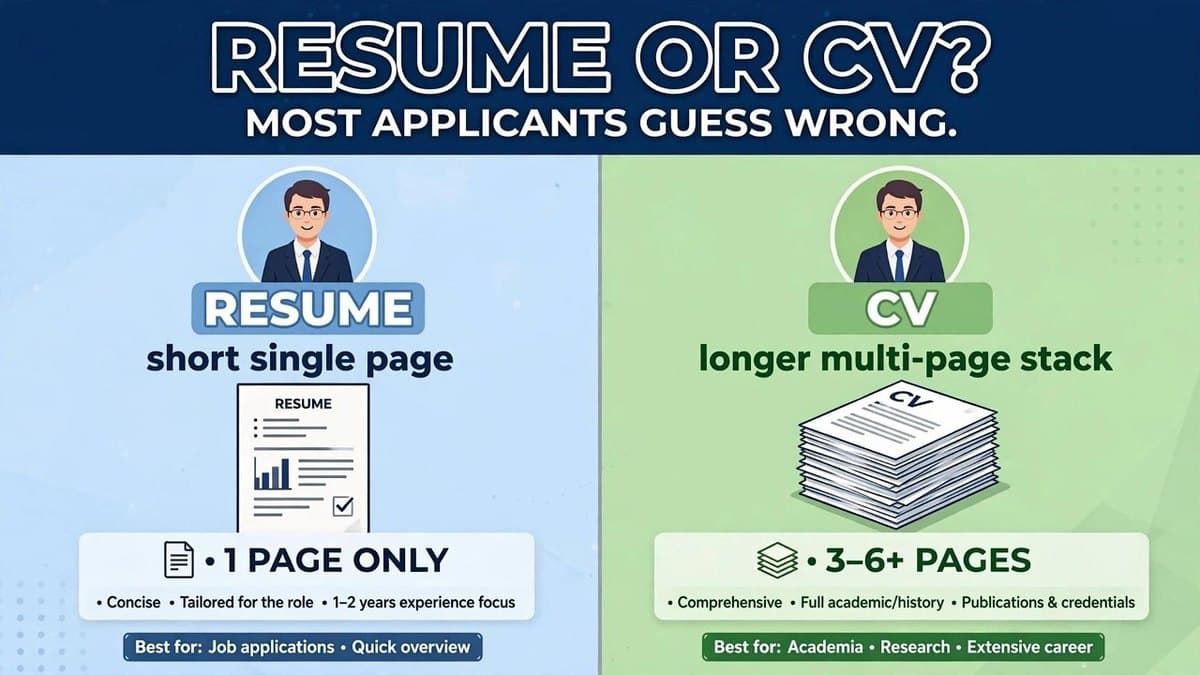
Resume vs CV for International Jobs: What's the Difference and Which One Do You Need?
The Job Search Confusion That Trips Up International Applicants
Written by Ron Kloth, Founder of NomadJobPass.
Quick answer: In the US and Canada, "resume" means a short (1–2 page) document tailored per job. "CV" means a long academic/research record. In the UK and most of Europe, "CV" is the term used for what's functionally a short resume, not the long US-style academic document. A resume and a CV aren't the same document with different names. Converting between them means adding or removing real content, not just relabeling a file.
My personal experience with conversions goes way back before modern software where it cost $100's of dollars to pay someone to write it properly.
If you've searched for job hunting advice online, you've seen both terms used, resume and CV, as if they're interchangeable. They're not, and which one you need (and what it should actually contain) depends heavily on where you're applying.
What Is a Resume?
A short, focused document highlighting your most relevant skills and experience for one specific job, a snapshot, not a full history.
- Length: usually one page, two for experienced professionals
- Purpose: a quick summary that grabs a recruiter's attention fast
- Focus: work experience and skills matched to the specific role
- Customization: tailored per application, not reused as-is
Recruiters spend roughly 6–7 seconds on an initial scan of a resume, TheLadders' eye-tracking research puts the figure at 6 seconds in 2012, updated to 7.4 seconds in a 2018 study with a larger sample. Whatever the exact number, the pattern is consistent: a resume has to be clean and scannable, not just complete.
What Is a CV?
Curriculum vitae, Latin for "course of life", a far more detailed document covering your full academic and professional history.
- Length: two pages or more, sometimes five-plus for academics
- Purpose: a comprehensive record of achievements, research, and publications
- Focus: academic and scholarly accomplishments
- Customization: less tailored per application, a living record you add to over time
The Geographic Divide
This is where it actually gets confusing, because the same word means different things in different places:
| Region | What They Call It | What It Actually Looks Like |
|---|---|---|
| US & Canada | "Resume" for most jobs, "CV" for academia/research | Resume: 1–2 pages, role-specific. CV: full academic record. |
| UK & Ireland | "CV" | Short (1–2 pages), functionally similar to a US resume |
| Most of Europe | "CV" | Often follows the Europass format. May include a photo |
| Australia & India | Used interchangeably | Both terms mean the same thing in practice |
When a European employer asks for a "CV," they usually want something close to a US-style resume, concise and role-focused. In North America, "CV" specifically means the long academic document. Getting this backwards is an easy, avoidable mistake.
What to Include in a Resume
Five sections distill your value: contact details, professional summary (2–3 sentences on what you bring), work experience with quantified impact, education/credentials, and skills. Each bullet uses "Accomplished X as measured by Y by doing Z" format. Space and scanability matter more than comprehensiveness. Every line competes for the recruiter's attention.
Name and contact info, a 2–3 sentence professional summary, work experience with measurable results, education, and both hard and soft skills.
For bullet points, the XYZ formula works well: "Accomplished X as measured by Y, by doing Z." For example: "Drove 2,500 organic signups to our monthly newsletter by A/B testing content layout, representing a 43% quarter-on-quarter increase."
What to Include in an Academic CV
Academic CVs prioritize scholarship and contribution: full education with thesis titles and advisors, research experience, teaching credentials, peer-reviewed publications (with full citations and your name bolded), conference presentations, awards, memberships, and references. Unlike resumes, depth and completeness matter more than brevity. Length reflects scholarly rigor, not verbosity.
Contact info, education (degrees, thesis titles, advisors), research experience, teaching experience, publications (full citations, your name bolded), presentations, awards/honors, professional memberships, and references.
When to Use Which
Use a resume when: applying for most jobs in the US or Canada, applying to industry/corporate/nonprofit roles, or the posting specifically asks for a resume.
Use a CV when: applying for academic, research, or faculty positions, applying to graduate programs, or applying in Europe/UK/elsewhere the local convention calls for a CV, but check local expectations first, since "CV" means different things in different places.
International Application Tips
Seven tactical steps prevent costly mistakes: research local norms (photo expectations differ), confirm paper size (A4 vs. US Letter), know Europass exists (EU standardization), verify "CV" definition (country-specific meanings), trim outdated history, complete LinkedIn, and tailor language for ATS. Each country interprets resume/CV conventions differently. What works in one region fails in another.
- Research local norms before applying. Germany commonly expects a photo. The US and UK discourage one.
- Check paper size. US/Canada use 8.5×11". Most of the rest of the world uses A4. Design for A4 if applying internationally.
- Know the Europass format exists. A standardized CV template established by the European Parliament and Council in 2004 to make qualifications easier to compare across EU countries. Some employers require it, most don't.
- Confirm what "CV" means for that specific employer: a US-style academic record, or a UK/EU-style short document. When in doubt, check the posting or ask.
- Cut high school and very old jobs once you have college or work experience. Most countries only want recent, relevant history.
- Include a complete, professional LinkedIn profile: an incomplete one can hurt more than including nothing.
- Tailor the language to the posting, even when submitting a similar base document each time. This matters for passing ATS screening as much as for a human reader.
The Digital Nomad Consideration
If you're applying across multiple countries, you may genuinely need both, a one-page resume ready for US/Canadian roles, a two-page CV ready for UK/European ones, plus a master document with everything, so you can tailor either version quickly per application.
Summary: Resume vs. CV at a Glance
Quick reference: US resumes are 1–2 pages role-specific. US CVs are 2+ pages with full academic history. EU CVs are 1–2 pages for job applications. Region matters: US/Canada use "resume" for industry jobs, "CV" for academia. UK/EU call all job documents "CV." Getting this backwards costs offers. Verify before applying.
| Resume | CV (US definition) | CV (European definition) | |
|---|---|---|---|
| Length | 1–2 pages | 2+ pages | 1–2 pages |
| Purpose | Snapshot for one application | Full academic/professional record | Job application document |
| Focus | Relevant skills and experience | Research, publications, academic history | Work experience and skills |
| Use case | Industry, corporate, nonprofit | Academic, research, medical, grad school | Most jobs in Europe/UK |
Related reading: The Interview Answer That Actually Works · CV definition
Sources
Resume and CV conventions vary by country, so confirm each one against the job posting and the employer's own guidance. The EU Europass framework is the main official reference linked below.
- TheLadders, eye-tracking study of recruiter resume-review behavior (2012, n=30 recruiters. Updated 2018 with a larger sample, average scan time 7.4 seconds).
- European Parliament and Council, Decision No 2241/2004/EC, establishing the Europass framework.