Employee vs. Freelancer: Which Digital Nomad Visa Can You Actually Get?
Written by Ron Kloth, Founder of NomadJobPass.
The Hard Truth: Most Digital Nomad Visas Default to Employment
Here's what the IBA's comprehensive Digital Nomad Report (March 2026) reveals: the vast majority of digital nomad visa schemes are built for traditional employees, not freelancers.
Out of 24 countries studied, only five explicitly welcome freelancers. The rest? They require a work contract with a foreign-based company—meaning you need an employer somewhere outside the country you want to live in.
This isn't an accident. Employment visas are easier for governments to track, verify, and tax. Your employer's work contract is proof. Freelance income is messier: multiple clients, invoices, variable earnings, complex tax questions.
But if you're freelance—and 40% of digital nomads are—this creates a real problem. You don't have a single employer. You have clients. And most countries haven't figured out how to handle that legally.
The good news: There are countries that have. And Albania, which the IBA report somehow missed, might be the best-kept secret among them.
The Default: Employment Visas (And Why They're Easier)
Before we get to the freelancer-friendly countries, understand the standard path.
Most digital nomad visas—Portugal, Greece, Malta, Croatia—follow the employment model. You need:
- A work contract with a company based outside the country
- Proof of income (usually €1,500–3,000 per month minimum)
- Tax documentation from your home country or employer's country
- A commitment that you're not taking local jobs
The ITA report confirms this is deliberate. Employment is verifiable. Freelance work is not—at least not in the way governments traditionally understand it.
Countries That Actually Welcome Freelancers
Here are the five countries from the IBA report that explicitly allow freelance work—plus Albania, the hidden gem they somehow omitted.
1. Spain — The Gold Standard for Freelancers
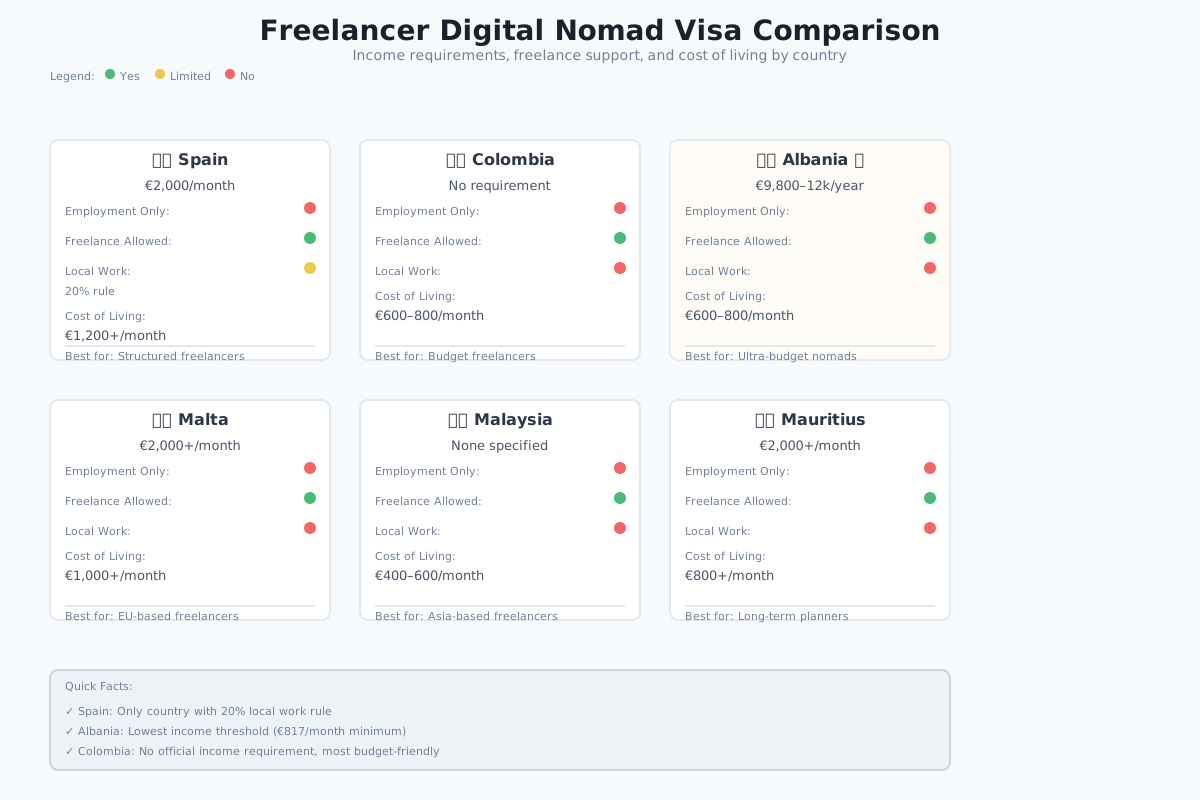
Income requirement: €2,000/month (about $2,200 USD) Work allowed: Unlimited freelance work worldwide Visa duration: 1 year (renewable)
Why Spain wins: Spain doesn't just tolerate freelancers—it has purpose-built structure for them.
The Visa de nómada digital requires you to prove remote work terms. You'll need:
- Terms and conditions of your remote work arrangement
- Client letter(s) of intent confirming ongoing work
- Bank statements showing regular deposits from clients
- Proof of income over the past year (tax returns or business registration)
The documentation is thorough but straightforward. Spain's tax authority knows how to handle self-employed people because Spanish freelancers exist everywhere.
The 20% Local Work Rule (Rare Advantage): Spain allows you to do up to 20% of your work for Spanish clients. This is a huge advantage. Most countries forbid any local work. Spain says: "Okay, but cap it."
What does this mean practically? If you earn €2,000 monthly, you can earn €400 from Spanish clients. This opens opportunities—teaching, consulting, local projects—that other countries prohibit outright.
2. Colombia — The Budget Alternative
Income requirement: None (tourism visa path) Work allowed: Freelance work (no formal visa yet, but accepted in practice) Visa duration: 90 days renewable
Colombia doesn't have an official "digital nomad visa," but it de facto welcomes remote workers. You enter on a tourism visa and work remotely without legal friction—provided you don't work for Colombian employers.
Why choose Colombia over Spain: Cost. Spain is expensive. Colombia is cheap. If your income is €1,500–2,000/month, you live well in Colombia. In Spain, you're cutting it close.
The tradeoff: Less legal clarity. Colombia is more "wink and nod" than Spain's formal structure. But for freelancers earning under €2,000, it's viable.
3. Malaysia, Malta & Mauritius — Emerging Options
These three round out the IBA report's freelancer-friendly tier:
- Malaysia: Explicit freelance acceptance, no income threshold
- Malta: €2,000+ income, freelance work allowed, English-speaking
- Mauritius: Growing interest in remote workers, low cost of living
None of these offer the legal clarity or 20% local work advantage of Spain. But all are viable for freelancers who meet their income thresholds.
Albania: The Hidden Gem (Not in the IBA Report)
Here's where personal experience matters.
The IBA studied 24 countries. They missed Albania—one of the most freelancer-friendly markets for lower-earning nomads.
Income threshold: €9,800–12,000/year
Official government sources cite €9,800. However, Sonila Demi, a leading expert at Expatsinalbania.com, suggests preparing for €12,000 based on recent administrative changes. No official confirmation exists for the €12,000 figure yet, but it's prudent to be prepared for the higher amount.
Why this matters:
- €9,800/year = €817/month
- €12,000/year = €1,000/month
Compare to Spain (€2,000/month) or Malta (€2,000+/month). Albania is half the cost. If you earn $800–1,200/month freelancing, Albania works. Spain doesn't.
Visa details:
- 1-year renewable visa for remote workers
- Explicit freelance work allowed
- Full Schengen-adjacent access (can travel EU visa-free as Albanian resident)
- Cost of living: €600–800/month (lowest among options)
Personal experience: I moved to Albania as a digital nomad knowing the official threshold. The bureaucratic process was straightforward, the tax treatment is clear, and the freelancer ecosystem is thriving. English is widely spoken; the nomad community is welcoming.
One caveat: Albania isn't as legally polished as Spain. The visa process is newer. But for freelancers on tight budgets, it's exceptional.
Comparison: Freelancer Visa Requirements by Country
What Freelancers Actually Need to Prove
Governments want verification. Here's what "proof" looks like using Spain as the template—which is the most transparent standard.
Documentation Required
Income proof:
- Last 12 months of business tax returns (or equivalent from your home country)
- Recent bank statements showing client deposits
- Invoices showing consistent work
Work terms:
- Copy of your remote work agreement or contract
- Letters of intent from primary clients confirming ongoing relationship
- Proof that clients are outside the visa country (no Spanish clients if applying for Spain visa, with the 20% exception)
Why it matters: You're not providing payslips. You're proving a pattern. Governments want to see consistent income over time, not a onetime deposit. They want to know you have multiple income sources (less risky than a single client).
The Albania difference: Requirements are similar but less formally documented. Expatsinalbania.com publishes the exact checklist; the process is more flexible than Spain's.
The 20% Local Work Rule: Spain's Rare Advantage
Most countries forbid any local work. You can't teach English. You can't consult for a local business. You can't freelance for local clients.
Spain has a loophole.
The Visa de nómada digital allows up to 20% of your work to be for Spanish clients. Legally. Officially.
What this enables:
- Teaching online to Spanish language students
- Consulting for Spanish startups
- Freelancing for Spanish companies on projects
- Building local business relationships (unlike other countries)
The caveat: Tax reporting gets complex. You'll owe Spanish income tax on that 20%. But you can do it—which is more than most countries allow.
If you plan to eventually settle and build local business ties, Spain's 20% rule is a massive advantage. Other countries force a binary choice: remote work only, or move to employment visa.
What Freelancers Should Do Before Applying
Don't assume your freelance setup qualifies. Here's the checklist:
- Verify income threshold — Does your monthly/annual freelance income meet the country's minimum?
- Document your clients — Can you prove ongoing relationships with 2–3+ clients?
- Check "local work" rules — Are your clients international, or do they include the destination country? (Spain allows 20%; most don't)
- Gather tax records — Last 12 months of business registration, tax returns, or equivalent
- Get client letters — Ask primary clients for a brief letter confirming ongoing work
- Check dual employment — If you have a part-time local job, that violates most visas
- Understand tax obligations — Tax residency and visa status are different. Consult a CPA
Red flags that will get you denied:
- Income below the threshold
- Clients all in the visa country (except Spain's 20% exception)
- No documented income history
- Evidence of local employment
The Bottom Line: Freelancers Have Options—But Verify
The IBA report is thorough but incomplete. It confirms that most digital nomad visas default to employment. But it misses Albania, which is arguably the best option for lower-earning freelancers.
Here's the real hierarchy:
- If you earn €2,000+/month and want clarity: Spain (20% local work rule is unmatched)
- If you earn €1,500–2,000/month on a budget: Colombia (lowest cost, no formal income requirement)
- If you earn €1,000–1,500/month: Albania (lowest income threshold, Expatsinalbania.com has all the details)
- If you want to explore: Malaysia or Malta for specific regions
Before applying, verify income requirements with the latest official sources. Governments update these rules. Albania's €12,000 threshold is recent enough that not all sources reflect it—which is why working with local experts like Sonila Demi matters.
Your next move? Pick your target country, confirm the current income threshold, gather your documentation, and apply. Freelance visas are entirely legal and increasingly common. You just have to prove the income.
Sources & Further Reading
- IBA Global Employability Index: Digital Nomad Report (March 2026) — Comprehensive study of 24 countries' digital nomad visa policies and employment requirements
- Expatsinalbania.com — Expert resource on Albania's digital nomad visa requirements and application process (by Sonila Demi)
- Verify all current income thresholds and visa requirements with official government immigration websites before applying, as requirements change frequently
Want to land remote work before you move? Check out NomadJobPass—the job board built specifically for distributed teams that accept international freelancers.